
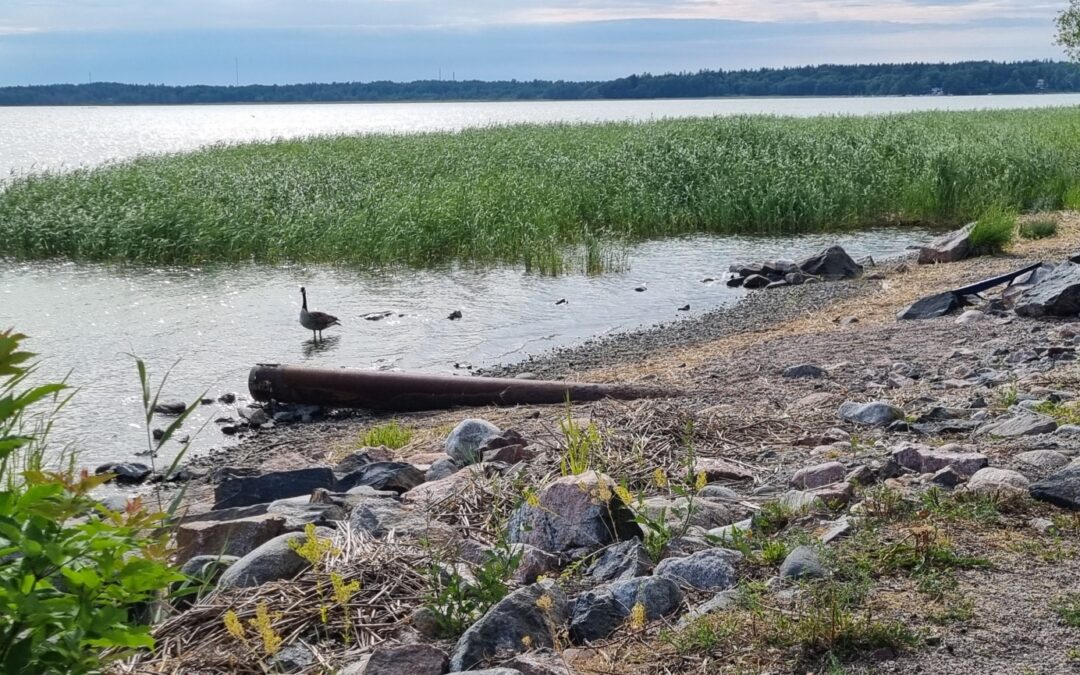
Did you know that the seas and inland waters of the European Union are assessed every six years according to common regulations? Throughout our district, we therefore share common water management objectives: to achieve and maintain at least a good ecological status for both inland waters and the marine environment. On the accompanying maps, all water bodies should ideally appear in blue or green.
This objective is laid down in the EU Water Framework Directive. The classification identifies water bodies where measures are needed to achieve the required environmental objectives. The ecological status is assessed every six years.
The Baltic Sea remains in a worrying condition
According to the Finnish Ministry of the Environment, the Baltic Sea continues to suffer from eutrophication, certain hazardous substances, and increasing human use of marine areas. Nevertheless, some Finnish marine areas are showing signs of improvement.
Eutrophication is caused by excessive concentrations of nutrients—primarily nitrogen and phosphorus—in seawater. Nutrient levels in the Baltic Sea peaked during the 1980s and 1990s and have since stabilised or declined.
The use of the most environmentally hazardous substances has been banned, and their concentrations in the sea have decreased. Today, certain flame retardants are among the substances causing the greatest concern.
Marine litter has become a major environmental issue, with most of the waste consisting of plastic. Underwater noise also disturbs marine wildlife.
The state of marine nature is mixed. Eutrophication remains the greatest threat, but invasive species, dredging, and coastal construction also have significant impacts. The condition of the seabed and the marine food web is poorest in the Gulf of Finland, where no clear signs of recovery have yet been observed. Among breeding seabirds, species feeding on bottom-dwelling animals are faring the worst, while grazing bird species have increased in number. Seal populations have generally increased, whereas many migratory fish species remain threatened.
Finnish Waters
According to the Finnish Ministry of the Environment, the status of Finland’s waters has remained largely unchanged compared with the previous 2019 assessment.
Of Finland’s lakes, 79%, and of its rivers 55%, have a good or excellent ecological status. Coastal waters are in poorer condition, with only 6% achieving good ecological status. Among groundwater bodies, 97% are in good chemical status, although a slight deterioration has been observed.
The next assessment of water status will be included in the 2028–2033 regional River Basin Management Plans, which will outline concrete measures to improve water quality.
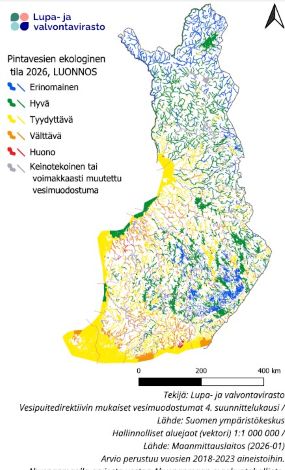
Figure. Preliminary ecological status of Finland’s surface waters, 2026
Estonian Waters
Similarly, 27% of Estonia’s lakes and 58% of its rivers have a good or excellent ecological status. Coastal waters do not achieve good ecological status. 99% of groundwater bodies are in good chemical status. The Estonian data are derived from Estonia’s WISE country report.
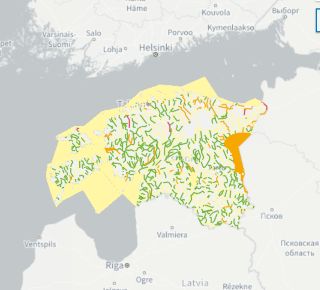
Figure. Ecological status of Estonia’s surface waters, 2025
Read more in the Baltic Sea section of the district’s website.
