
State of the Environment
The State of the Baltic Sea Remains Concerning
Human activities affect the Baltic Sea in many ways. Invasive species spread through shipping, nutrients and harmful substances enter the sea from land and maritime transport, and the increasing use of plastics and synthetic fibres contributes to marine litter. Shipping, construction, offshore wind farms and other uses of the sea also generate underwater noise and changes in currents, wave conditions, water temperature and salinity.
The objective of water management for 2027 is that all waters should achieve at least good ecological status and that the deterioration of water bodies should be prevented across the EU. The accompanying figure shows the status of Finland’s inland and coastal waters in 2019. Green and blue indicate good and excellent status. The status of waters is assessed every six years.
The Baltic Sea is monitored continuously. Monitoring programmes observe eutrophication, water quality, marine biodiversity and other aspects of marine well-being. Based on these observations, an assessment is made for each component. The goal is for every component to reach good status.
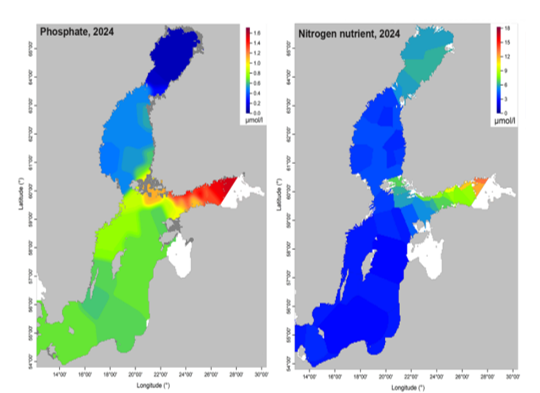
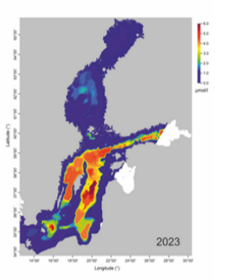
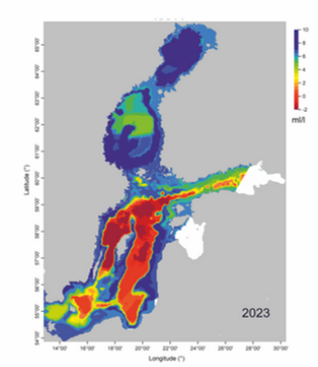
However, there is still a long way to go. This is illustrated, for example, by SYKE’s maps of bottom phosphorus and oxygen concentrations published in August 2023. In the oxygen map, red indicates oxygen-depleted bottoms and blue indicates good conditions. Organic material that settles on the seabed decomposes, consuming oxygen and releasing phosphorus. During the following summer, phosphorus is again absorbed by growing algae. Phosphorus inputs should be reduced and, where possible, removed from water systems.
Over the past decades, increasing water temperatures have contributed to the worsening situation.
Information about the Baltic Sea and water conditions is available on several websites, including environmental and water information portals.
https://www.ymparisto.fi/fi/ympariston-tila/vesi/itameren-tila
https://www.ymparisto.fi/fi/luonto-vesistot-ja-meri/meri/suomen-meriymparistontila-2024
https://itameri.fi/itameren-tila/merenpohjan-tila-2/hapettomat-pohjat/
https://www.europarl.europa.eu/topics/en/article/20250428STO28142/europe-swaters-key-challenges-and-eu-solutions
https://www.vesi.fi/teemasivut/
https://www.vesi.fi/karttapalvelu/
Climate Change
Climate change is one of the most serious environmental challenges facing humanity. It is closely linked to biodiversity loss and unsustainable consumption and production patterns.
Climate Change in the Baltic Sea
As winters become warmer and precipitation increases, the Baltic Sea warms, ice cover decreases and salinity declines. There is no other sea in the world with similar characteristics.
Sea temperature has risen by about 2 °C since 1980, and in the northern Baltic Sea it is projected to rise by another 2–4 °C by 2100. Ice cover may shrink to about half its current extent, which may help winds mix oxygen into deeper waters. At the same time, internal processes in the sea may increase oxygen consumption. Water stratification may intensify, increasing oxygen deficiency. Sea level rises, and winter rains wash more nutrients and soil into the sea. Eutrophication and cyanobacterial blooms increase, further worsening oxygen depletion.
Climate Change and AMOC
Finland’s climate is strongly influenced by the Atlantic Meridional Overturning Circulation (AMOC) in the North Atlantic. It is driven by winds and differences in water density. Warm surface water near the equator flows northward, releases heat to the atmosphere and becomes denser, sinking toward deeper layers. At the same time, colder water flows southward near the seabed.
.
The most important warm currents in the AMOC system are the Gulf Stream and the North Atlantic Current. The Gulf Stream carries warm water from the Caribbean along the eastern coast of North America and further northeast toward northern Europe. This heat transport makes northern Europe milder than other regions at similar latitudes, such as Canada.
Due to climate change, surface waters moving north lose less heat than before and increasingly mix with freshwater, which is lighter than saltwater. As a result, AMOC circulation is expected to weaken. A rapid slowdown has been discussed but is currently considered unlikely.
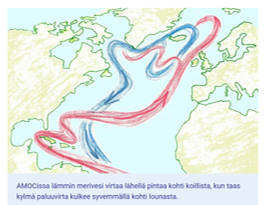
A Nordic report on possible tipping points in the AMOC circulation calls for stronger climate mitigation, monitoring and preparedness.
A report published on 5 February 2026 compiles scientific knowledge about the potential impacts of an AMOC collapse in the Nordic countries and provides recommendations for policymakers.
Pohjois-Atlantin kiertoliike AMOC (engl. the Atlantic Meridional Overturning Circulation) transports heat to the North Atlantic and contributes to the relatively mild climate of the Nordic countries. Global warming slows down the AMOC cycle. It is unlikely but possible that the AMOC could even stop as a result of relatively minor warming. Such a change in the AMOC cycle could turn the climate in northern Europe colder as the rest of the world continues to warm. The effects would be visible in food and energy production and people’s livelihoods, among other things.
https://www.ilmatieteenlaitos.fi/merivirrat
https://www.ilmatieteenlaitos.fi/tiedote/6TWTzExsFgEalSzhDcpkCw
https://pub.norden.org/temanord2026-504/
https://www.acccflagship.fi/wp-content/uploads/Tipping_points_Policy_Brief_suomi.pdf
