
Environment and the Baltic Sea
Caring for the Environment
Rotarians are committed to supporting activities that strengthen the conservation and protection of natural resources, promote ecological sustainability, and maintain a balance between communities and nature. We support projects that address the causes of climate change and environmental degradation with the aim of reducing their harmful impacts.
The goal of the Baltic Sea Forum is to support and inspire the clubs in the district in their water protection and environmental work. Clubs carry out water and environmental protection activities either together or independently: from fundraising and increasing awareness about the Baltic Sea to concrete projects, cooperation with other stakeholders and volunteer work. All clubs can participate in project funding by supporting The Rotary Foundation.
The Baltic Sea catchment area covers a land area four times larger than the sea itself and extends across more than ten countries. In addition to our district areas of Uusimaa and Estonia, it includes almost all of the rest of Finland, Sweden, Denmark, Latvia, Lithuania and Poland. Waters from Germany and Russia also flow into the Baltic Sea. Work done for nearby waters, both on the coast and inland, benefits the entire Baltic Sea region and its ecosystems, of which we humans are also a part.
Contact information for the Baltic Sea Forum
The Baltic Sea Forum acts as one of the district committees of Rotary District 1420. You can find the committee members and contact information in the district organization using this link.
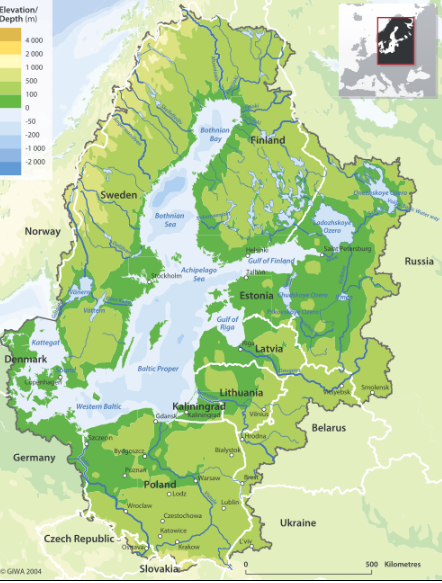
The Baltic Sea catchment area
Rotarian District 1420 participates in the Baltic Sea Challenge
The greatest threats to the sensitive Baltic Sea know no borders between states or municipalities. That is why Turku and Helsinki invited different actors to participate in the conservation work. Since 2007, more than 330 organisations have committed to the Baltic Sea Challenge through various measures. Over the years, the members have gotten to know each other, shared information with each other and carried out joint water protection work.
Our commitment lays the foundation for the work of the Baltic Sea Forum.
https://itamerihaaste.fi/verkostojasenet/rotarypiiri-d1420-uusimaa-ja-viro/
https://itamerihaaste.fi/
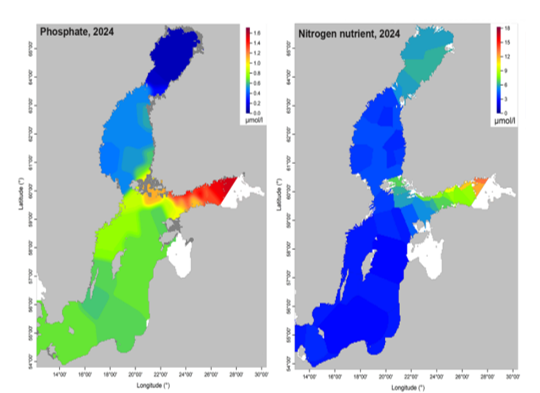
The State of the Baltic Sea
Human activities affect the Baltic Sea in many ways. Invasive species spread through shipping, nutrients and harmful substances enter the sea from land areas and maritime transport, and the increasing use of plastics and synthetic fibres contributes to marine litter. Shipping, construction, offshore wind farms and other uses of the sea also generate underwater noise and changes in currents, wave patterns, water temperature and salinity.
Climate Change in the Baltic Sea
Climate change is one of the most serious environmental challenges facing humanity. It is closely linked to the loss of biodiversity and to unsustainable consumption and production patterns.
As winters become warmer and precipitation increases, the Baltic Sea warms, ice cover decreases and salinity declines. There is no other sea like it anywhere in the world
Climate Change and AMOC
Finland’s climate is strongly influenced by the North Atlantic circulation known as AMOC (Atlantic Meridional Overturning Circulation). It is driven by winds and differences in water density. Warm surface water near the equator flows northward, releasing heat into the atmosphere and becoming denser before sinking toward deeper layers. At the same time, colder water flows southward near the seabed. The most significant warm currents in the AMOC system are the Gulf Stream and the North Atlantic Current.
Climate challenge for clubs
Welcome to learn more about the clubs’ climate work!
In the spring of 2023, the Environmental Sustainability Rotary Action Group ESRAG challenged clubs to consider their own carbon footprint and find ways to slow down climate change.
Find out how the clubs in our district can also turn into a climate club step by step.
Rotarians Monitor the Environment
Rotary clubs participate in several environmental monitoring projects, including:
• beach litter monitoring
• Baltic herring rowing fundraising events
• cyanobacteria (blue-green algae) monitoring
• the Water Backpack system developed with the Finnish Environment Institute (SYKE) for schools to study water ecosystems.
Rotarians Take Environmental Action
Rotary clubs participate in environmental projects such as:
• restoration of the Vantaa River watershed
• water protection projects in the Seurasaari area
• water conservation activities in eastern Uusimaa
• the Gumböle fish ladder project in Espoo
• the digital nature trail in Tapiola’s Silkkiniitty park.
Cooperation Partners
Partners of the Baltic Sea Forum include:
• the Ministry of the Environment
• the Finnish Environment Institute (SYKE)
• Centres for Economic Development, Transport and the Environment
as well as organisations such as:
• BalticSea.fi
• John Nurminen Foundation
• Baltic Sea Action Group
• WWF
• Keep the Archipelago Tidy Association.
International Cooperation
The Baltic Sea Forum cooperates with several international organisations, including:
• BASRAN – Baltic Sea Regional Action Network
• ESRAG – Environmental Sustainability Rotary Action Group
• CAFW – Community Action for Fresh Water (UNEP initiative).
Testing Rotarians
Every club climate friendly
As pollution levels rise and the world warms, storms and droughts intensify and harm people. How can Rotarians help?
Sitran elämäntapatesti
Sitran elämäntapatesti auttaa löytämään omiin arvoihin ja elämäntilanteisiin sopivia valintoja, joiden avulla voi elää itsensä näköistä hyvää elämää ja hillitä ilmaston kuumenemista.
