
The Rotary Foundation is Rotary International’s own foundation and one of the world’s best-known and most reliable funders of good deeds. Its basic mission is simple: it collects donations and turns them into grants to fund humanitarian projects carried out by Rotarians, both in their own community and internationally.
“The best thing about district grants is that they bring Rotary’s impact into our everyday lives. Even a small amount of funding can create a sense of community, joy and concrete help, as long as the project is based on a real need and is well planned,” says Irmeli Viherluoto-Lindström, Chair of our district’s Rotary Foundation Committee.
How does a donation turn into a grant?
At the end of the Rotary year, donations made by clubs and districts to the Annual Fund (SHARE) will be invested for three years to grow. After this, the funds will be returned to Rotary activities so that they are divided into both the district’s own funding base (District Designated Fund, DDF) and the Rotary Foundation’s World Fund. In practice, this makes it possible for the district and clubs to apply for funding for their own projects. At the same time, the Rotary Foundation supports global, common goals.
District Grants and Global Grants—What’s the Difference?
District grant projects are often projects that start faster and are related to one’s own community or a limited site. They can be local or international, but usually short-term and concrete. The district administers applications and applies for funding from the Rotary Foundation.
Global Grant projects, on the other hand, are large-scale international projects, vocational training teams, or study scholarships that must have a lasting and measurable impact on the Rotary Foundation’s focus areas. They require an international partnership, direct approval from the Foundation, and significant funding.
What kind of projects are suitable for foundation funding?
Projects that address a clear local need and have a long-term impact are best suited for funding. Examples include projects related to the environment, education and health. Projects that strengthen the sense of community and bring joy and inclusion to people who would otherwise not have the opportunity to do so are also recommended.
The top priority for Rotary and the Rotary Foundation remains the eradication of polio from the world. Therefore, donations to the PolioPlus Fund are of paramount importance. Our district is on a good track in polio donations, but the work is not yet complete.
Another key entity is the service activities of the clubs and district grant projects as well as donations to the Annual Fund. This is where the district’s foundation committee encourages us to steel ourselves: donations make grants possible, and grants enable projects.
Smoother search and earlier schedule
The District 1420 Foundation Committee has updated the materials and clarified the application process. At the same time, the application period for grants has been brought forward. The date is now 1.11.–15.3. In addition, clubs are encouraged to contact the Foundation Committee already in the planning phase so that the application meets the requirements and the grants are available to the clubs before the summer holidays.
During the spring, the committee will also prepare for a change of duties when Thor Vaenerberg becomes the chairman of the Rotary Foundation Committee. The Committee is also happy to welcome new Rotarians interested in Foundation activities.
Do you need help with an idea or application?
The first step for a club is to choose a project idea and start planning. At the same time, the club also plans a fundraiser to cover its own financial contribution, makes donations to the Annual Fund and takes care of participation in the training required by the Rotary Foundation and the district.
In the next step, the club contacts the district’s Rotary Foundation Committee during the planning phase. This contact is a prerequisite to ensure that the project meets the requirements of the TRF and the district. After this, the final grant application is prepared in accordance with the instructions on the application form.
Three examples of what grants can achieve:
- Vihti RC’s “Our Vihti” photography competition (2020) for immigrants brought together Vihti residents from different backgrounds and culminated in a library exhibition: a lot of community and good mood with a small amount of funding.
- The Munkkiniemi RC school water backpack project (2023) promotes environmental education and inspires schools and clubs to cooperate in the use of water backpacks in teaching.
- Tallinn International RC’s 3D scale model of Tallinn’s Town Hall Square makes the UNESCO World Heritage Site more accessible to the visually impaired – and at the same time can be experienced by all city residents and tourists.
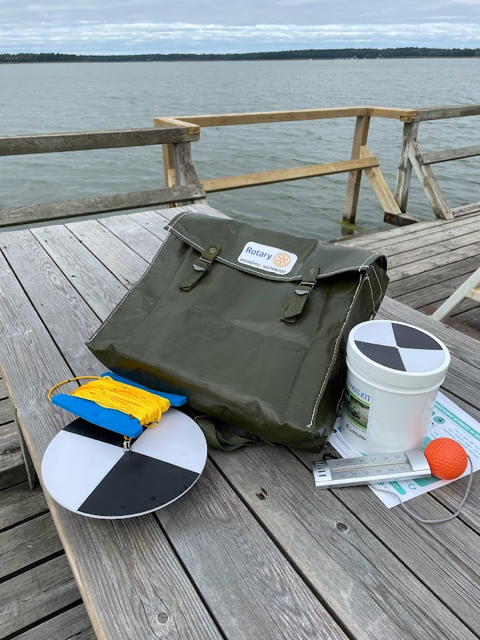
Caption: The Munkkiniemi Rotary Club’s water backpack project inspires schools to engage in environmental education.
